
Table of Contents
Last update: July 2026. All opinions are my own.
GenAI Engineering — Interview Prep · Part 1/15
This is the personal-preparation part of the series — the meta layer before the technical deep dives. If you're here for the concepts, skip to Part 4: The cheatsheet or Part 5: LLM Foundations.
The role I'm interviewing for
GFT · AI Engineer (Generative AI & Data Science Solutions), based in Madrid / Alicante / Lleida / Sant Cugat / Valencia / Zaragoza. Working in their AI.DA Center of Excellence on AI-centric transformation for banking, insurance, and industrial clients.
The JD lists these skill areas explicitly:
- Multi-agent patterns (skills + subagents)
- Prompt engineering
- State + memory management
- RAG
- Reasoning loops / planning
- Tool design + error handling
- Interoperability + LLMOps
- Guardrails
- Cost + latency optimization (Python, Java, Kafka, microservices)
And the requirements: 5+ years software dev, Python (mandatory), 6+ months GenAI/DS (TF, PyTorch, LangChain, etc.), backend + microservices, Git + CI/CD, one cloud (AWS/GCP/Azure), team leadership, agile methodology, ideally B2/C1 English.
My strengths (honest)
1. Strong ML/DS foundation, deep and visible. I don't just say "I know ML" — the ML from Scratch series is 12 posts covering everything from data cleaning through PCA, cross-validation, boosting, KNN. The NLP from Scratch series is another 9 posts. Every post has diagrams I made, formulas I wrote out, and cheatsheets I can hand someone. That's not "I read a book" — that's "I taught it".
2. Active learning velocity. The whole GenAI Engineering series you're reading right now was assembled in ~2 weeks specifically to close a gap I identified after reading the JD. That's the pace they need in a consultancy that ships AI transformation to enterprise clients.
3. Python + practical portfolio. Kaggle-style projects across forest cover prediction, bike sharing demand, Mercedes hackathon, Instagram graph analysis. All Python, all reproducible, all written up so someone else can run them.
4. Communication + teaching. 20+ published technical posts. Every one uses the StatQuest school of NLP: visual first, "you" and "imagine", zero condescension, no padding. In a consultancy where you have to explain LLMs to a bank's risk committee, this is not a bonus skill. It's the job.
5. Full-stack ownership. This site — mariaa.tech — is Next.js on Vercel, GitHub main branch auto-deploys, MDX content pipeline, brand system, cheatsheet route. I built and ship it. I understand how to deploy things, not just how to model them.
6. Curiosity that shows up on the page. Every post starts with "why does this exist" and ends with "here's what to try next". That mindset transfers directly to consulting engagements — you have to figure out what the actual problem is before you build.
My weaknesses (honest)
1. Production GenAI shipping is limited. I've built visual explainers of RAG, agents, guardrails. I have not (yet) shipped a RAG system into a bank's production environment behind a real SLA. That's the gap. In the interview, I'll frame it as: "I know the shape of the problem end-to-end; the piece I want to grow into is the production hardening — load testing, cost monitoring, incident response for LLM-based systems."
2. Team lead experience below what the JD asks. The JD says "gestión y liderazgo de equipos técnicos" and my direct team-lead history is more limited than a 5+ year senior lead. I have led project-scoped groups on hackathons and my thesis, but not a permanent team. Framing: "I've led project-scoped teams and I want to grow into a permanent tech lead role — the CoE format is a great learning environment because senior architects are around."
3. Java + Kafka not primary. The JD lists Python, Java, Kafka, microservices. Python is home. Java + Kafka I've read and prototyped but never shipped in production. Framing: "Python is my primary; I've done Java in one project and I'd close the Kafka gap in the first month — the concepts (event streams, async processing) map to things I already understand."
4. LangChain in production is theoretical. I've used the LangChain / LlamaIndex libraries in notebooks. I have not architected a production LangChain deployment with retries, caching, guardrails, and observability. Framing: "I know the abstractions; I want to grow into designing the reliability layer around them — which is why LLMOps is one of the topics I studied hardest for this interview."
5. Multi-agent at scale is a study topic, not a shipped project. Same shape as #1 but specifically for orchestrator / hierarchical / network patterns. I know the patterns from the literature and from LangGraph / crewAI / AutoGen documentation. I haven't run a production multi-agent workflow. Framing: "I've studied the patterns and prototyped a planner-executor in a notebook — the CoE would be where I get to actually ship one."
How I'll answer "what's your weakness" in the room
The wrong answer is "I'm a perfectionist". The right answer names something real, shows self-awareness, and demonstrates the fix already in progress.
My planned answer:
"The honest answer is that production GenAI shipping — RAG in prod with real SLAs, multi-agent workflows with error budgets, LLMOps for cost monitoring — is where I have the most learning ahead of me. I've studied the patterns closely — this whole GenAI interview series I built while preparing for this role is basically that studying made visible — and the CoE at GFT is exactly the environment where I want to close the loop between what I know conceptually and what I've shipped in anger. I already know the shape of what I need to learn, which is half the battle. The other half is doing it with a senior team around me."
That answer:
- Names a real weakness (production experience)
- Doesn't disqualify me (I know the concepts)
- Shows self-awareness (I built a whole series to prep)
- Ties back to what they need (a CoE with growing engineers)
- Ends on a positive (already in motion)
What I'll lead with
If they ask "tell me about yourself", my 90-second version:
"I'm a data + AI person coming from a strong ML foundation — I built two open technical series covering the ML and NLP courses I took, plus a Kaggle-style portfolio of end-to-end projects (forest cover, bike sharing, Mercedes hackathon). Over the last few months I've been going deep on the Generative AI stack — LLMs, RAG, agents, LLMOps — because that's where the interesting engineering problems have moved. Everything I've studied is published on mariaa.tech, including a 4-page cheatsheet for this exact interview loop. I want to work at GFT specifically because the CoE model gives me both real client problems and senior architects to learn the production side from — and because AI-centric transformation for banking + insurance is where GenAI actually has to work under real constraints."
Sub-90 seconds if I'm crisp. It tells them: technical depth, communication skill, self-directed learning, clear reason for wanting this specific role.
What's next in this series
- Part 2: Why I want to work for GFT — the deeper "why this company"
- Part 3: Questions I have to ask GFT — the questions I'll bring to the interview
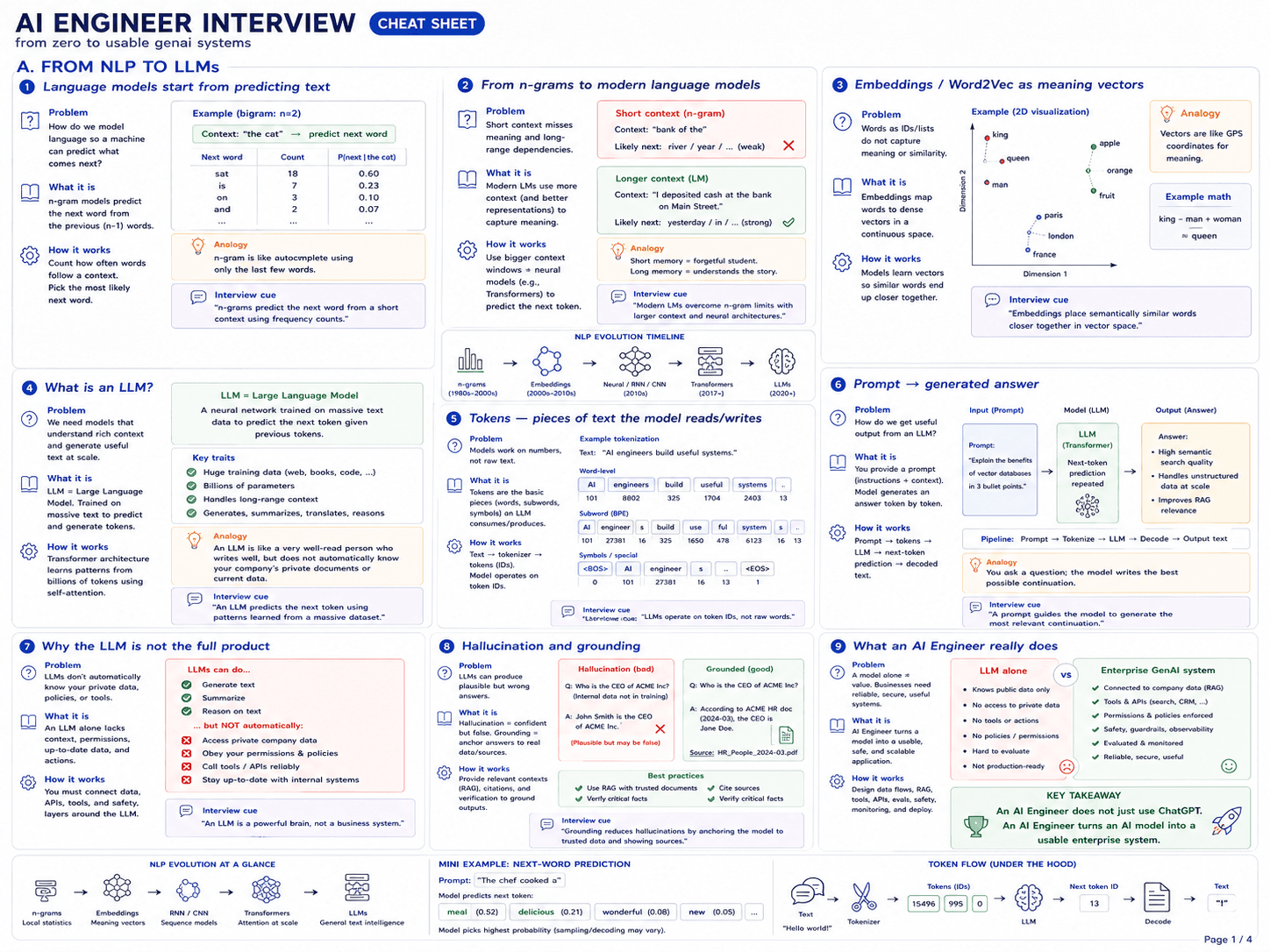
- Part 4: The cheatsheet — the visual overview
- Part 5 onwards: The technical deep dives