
Last update: July 2026. All opinions are my own.

GenAI Engineering — Interview Prep · Part 1

📄 Download the full 4-page PDF — printable, easy to skim on the train the morning of.

What this is

I built this while prepping for a real interview for a Generative AI Engineer role. The scope was very specific — modern LLM engineering, not classical NLP or ML. Every topic on these four pages appeared in either the job description or an interview loop.

It's dense on purpose. Three columns per page, one concept per numbered block, small diagrams where they add signal. Use it as revision — read the deeper material in the rest of this series if a concept is still fuzzy.

Page 1 · LLM Foundations
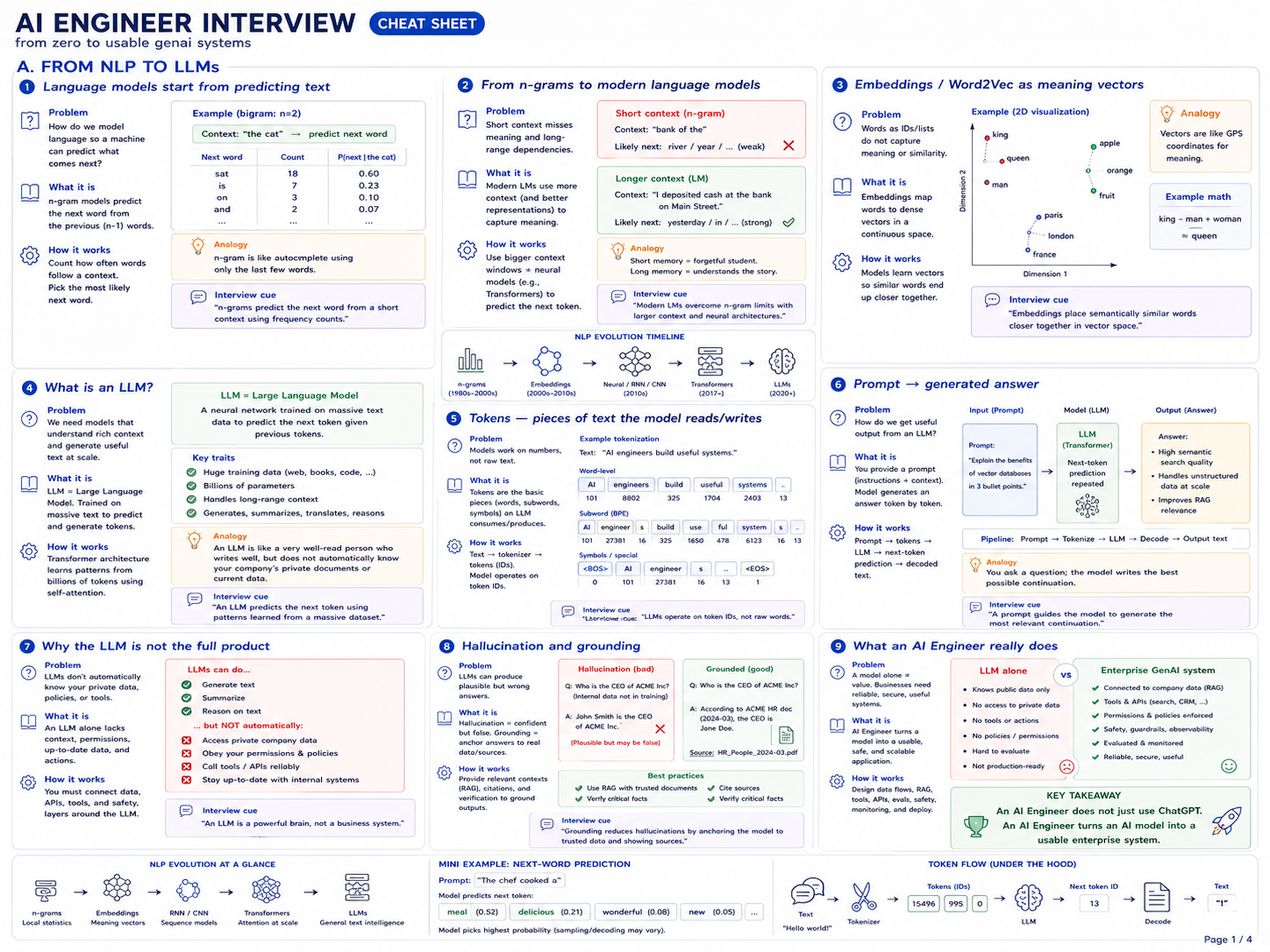
Page 1 of 4 — LLM Foundations. Nine numbered concept blocks in a dense 3-column layout: (1) What is a Large Language Model, (2) Transformer + self-attention, (3) Tokens and context window, (4) Pretraining → instruction tuning → RLHF / DPO three-stage pipeline, (5) Sampling: temperature / top-k / top-p / greedy, (6) Prompt structure: system / user / assistant roles, (7) Zero-shot vs one-shot vs few-shot in-context learning, (8) Chain-of-thought prompting basics, (9) Scaling laws + emergent behavior. Navy headings, slate-blue accents, off-white background.
The transformer + LLM refresher. If you can't explain the three-stage post-training pipeline (pretrain → instruction-tune → RLHF/DPO), start here.

Page 2 · Prompting + Reasoning Loops

Page 2 of 4 — Prompting + Reasoning Loops. Ten numbered concept blocks: (10) Prompt engineering principles (task/context/constraints/examples/output format), (11) Task decomposition, (12) Chain-of-thought (deeper — reasoning traces), (13) Self-consistency (sample multiple CoTs, majority vote), (14) Tree of Thoughts (ToT), (15) ReAct pattern (Reason + Act loop), (16) Planner-Executor pattern, (17) Reasoning loops / iterative refinement, (18) Reflection / self-critique, (19) Structured output (JSON mode, function calling). Includes a ReAct loop diagram and a small tree diagram for ToT.
From single-shot prompts to reasoning loops. ReAct and the planner-executor pattern are the ones that come up in agent design questions.

Page 3 · RAG + Memory + State

Page 3 of 4 — RAG + Memory + State. Nine numbered concept blocks: (20) RAG pipeline overview (query → retriever → context → LLM → answer), (21) Embeddings + vector databases with a comparison chart, (22) Chunking strategies (fixed, semantic, sliding window), (23) Retrieval: sparse (BM25) vs dense vs hybrid, (24) Reranking with cross-encoders, (25) Short-term vs long-term memory, (26) Session state / conversation memory, (27) Semantic cache, (28) RAG evaluation (faithfulness, context precision, answer relevance). Includes a compact end-to-end RAG diagram and a sparse-vs-dense-vs-hybrid trade-off table.
The retrieval half of production LLM systems. RAG is the single most-asked topic in this class of interview — the questions almost always drill into chunking, reranking, and evaluation.

Page 4 · Agents + Tools + Guardrails + LLMOps

Page 4 of 4 — Agents + Tools + Guardrails + LLMOps. Ten numbered concept blocks: (29) Multi-agent patterns (single, orchestrator, hierarchical, network), (30) Skills + subagents, (31) Tool / function calling design (name, description, args schema), (32) Tool error handling (retries, timeouts, fallbacks, arg validation), (33) Guardrails: input filters + output filters, (34) Prompt injection defense (allowlists, delimiters, LLM firewall), (35) Security: PII redaction, data leakage, allowlisted tools, (36) LLMOps: monitoring, tracing, evaluation, dataset curation, (37) Cost + latency: batching, streaming, model routing, caching, quantization, (38) Deployment: Python + microservices + Kafka + observability. Includes a multi-agent diagram, a tool schema example, and a cost/latency trade-off table.
The engineering side. Multi-agent patterns, tool calling, prompt injection defense, LLMOps, cost and latency — the stuff that turns a chat model into a shipping product.

The recommended study path

For each cheatsheet topic, here is the deeper post to read if you want the why:

  1. LLM foundations (page 1)NLP Part 5: Language Modeling covers n-grams → RNN → transformers → BERT → GPT → distillation. Read this if the three-stage pipeline is fuzzy.
  2. Fine-tuning + transfer learningNLP Part 7: Text Classification (Deep Learning) walks the transfer-learning workflow that most fine-tuning questions are actually about (catastrophic forgetting, LR finder, gradual unfreezing).
  3. Retrieval (page 3)NLP Part 8: Information Retrieval covers the classical retrieval stack (inverted index, TF-IDF, BM25) that RAG rebuilds on top of.
  4. QA + tool-use patternsNLP Part 9: Question Answering is the closest existing post to reasoning-loop and tool-use questions. Read alongside page 2 of the cheatsheet.

The full recommended path lives at /series/genai-interview-prep.

What's still coming

Two topic areas from the cheatsheet are only lightly covered in the current series posts and deserve their own deep dives. Both are on the list to write next:

  • Modern GenAI Engineering — a full post covering the pages 2, 3, 4 material (prompting patterns, RAG in production, agents, LLMOps) at the same depth as the NLP from Scratch series.
  • RAG in production — chunking strategies, hybrid retrieval, reranking, semantic caching, and how the classical IR from Part 8 becomes the R in RAG.

For now, the cheatsheet is the summary. If you're prepping for a similar interview and want a specific topic expanded first, that's the shortest way to make it happen.

What was in the job description

For context — the interview this was built for asked explicitly about: multi-agent patterns · prompting · state and memory management · RAG · reasoning loops · tooling design · tool error handling · security and LLMOps · guardrails · cost and latency. Every one of those maps to a concept block above (numbers 6–38). The mapping is annotated on the series page.

If your interview looks similar — GenAI-focused, LangChain-adjacent, cloud + microservices deployment context — the four pages should cover most of the surface. If it's more traditional Data Science or classical ML, you probably want the ML from Scratch series instead.

Good luck.