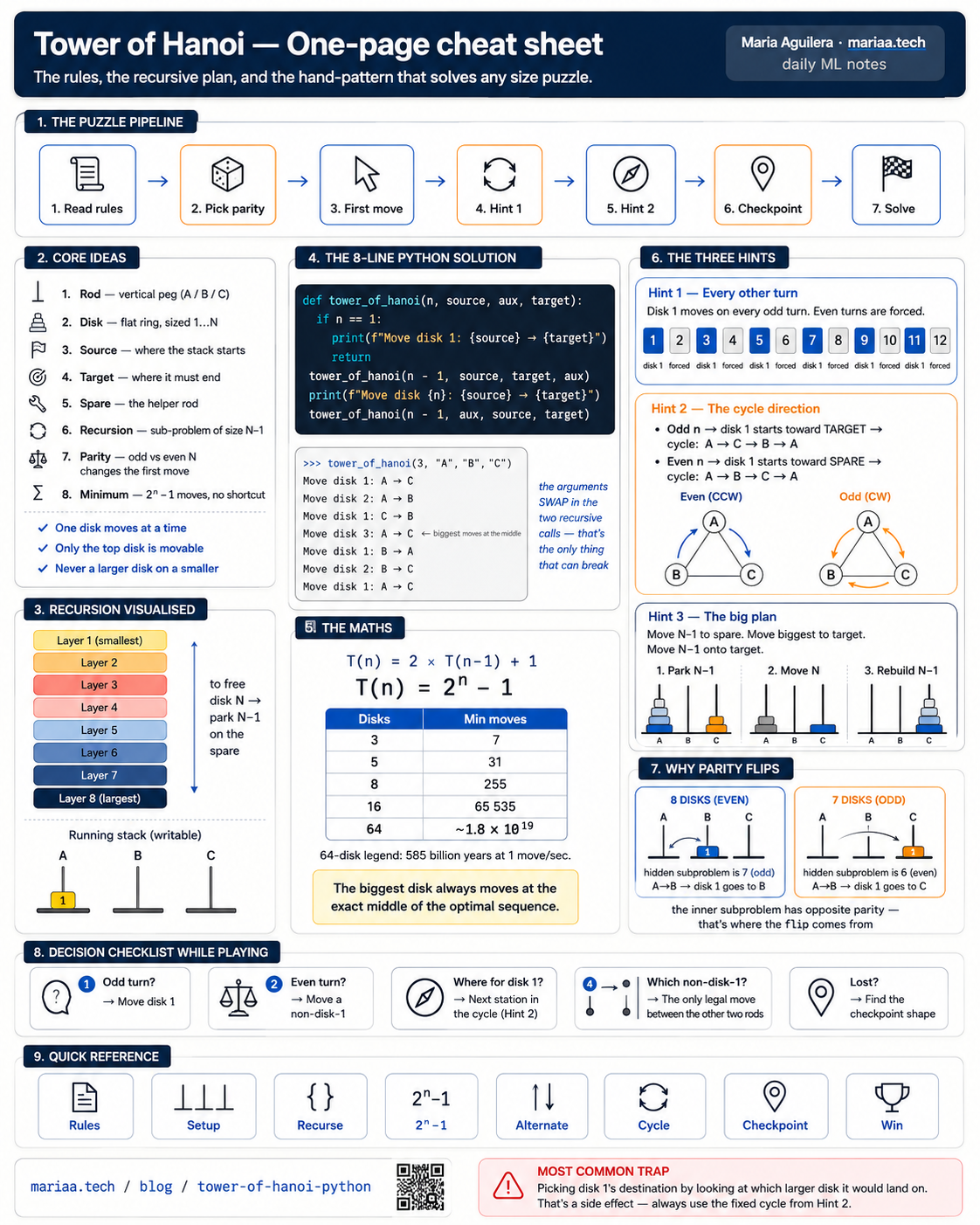
def tower_of_hanoi(n, source, auxiliary, target):
    if n == 1:
        print(f"Move disk 1 from {source} to {target}")
        return
    tower_of_hanoi(n - 1, source, target, auxiliary)
    print(f"Move disk {n} from {source} to {target}")
tower_of_hanoi(n - 1, auxiliary, source, target)The rules
Three rods (A, B, C) and n disks stacked on A in ascending order — smallest on top, largest on the bottom. The goal: move all disks to C obeying:
- One disk at a time.
- Only the top disk of a stack is movable.
- A disk may never sit on a smaller one.
The middle rod B is the spare — sometimes called the auxiliary.
The 8-line recursive solution
tower_of_hanoi(3, "A", "B", "C")The roles of the rods swap in the recursive calls. That swap is the only place this code can break.
The maths: 2ⁿ − 1
Minimum number of moves for n disks:
T(n) = 2 × T(n−1) + 1 with T(1) = 1
Solving the recurrence:
T(n) = 2ⁿ − 1
| Disks | Min moves |
|---|---|
| 3 | 7 |
| 5 | 31 |
| 8 | 255 |
| 16 | 65,535 |
| 64 | ~1.8 × 10¹⁹ |
Side fact: the biggest disk always moves at the exact middle of the optimal sequence. Halfway through and it hasn't moved? You took a detour.
Hand-pattern: hint 1 — every other turn
The smallest disk moves every other turn. The moves in between are forced.
- Odd turns (1, 3, 5, …) → move disk 1.
- Even turns (2, 4, 6, …) → move some other disk.
The "forced" move: after disk 1 moves, look at the other two rods. Between them there's only one legal move — the other would put a larger disk on a smaller one.
Hand-pattern: hint 2 — which direction
Odd total disks → disk 1 starts toward the target. Even total disks → disk 1 starts toward the spare.
After the first move, disk 1 follows a fixed cycle:
Odd nA → C → B → A → …
Even nA → B → C → A → …
Read it like a clock — next station in the cycle, never left/right.
Hand-pattern: hint 3 — the big plan
To move N disks A → C, first move N−1 disks A → B. Then move the biggest disk A → C. Then move N−1 disks B → C.
This isn't a tactical hint — it's the strategic checkpoint.
For 8 disks: the big checkpoint is when disks 1–7 are parked on B and disk 8 sits alone on A. One move lands disk 8 on C; the rest is a 7-disk puzzle from B → C.
If you ever feel lost, recognise the checkpoint shape: "I'm trying to free disk N — every smaller disk must be off the way."
Why parity flips the start
The first goal is always free the biggest disk — which means stacking the N−1 disks above it on the spare.
That hidden subproblem is itself a Tower of Hanoi — but with N−1 disks, opposite parity to the outer puzzle. Disk 1's first move follows the inner subproblem's rule:
- 8 disks (even): subproblem is 7 (odd) A → B. Odd ⇒ disk 1 toward target. Target is B. Disk 1 goes to B.
- 7 disks (odd): subproblem is 6 (even) A → B. Even ⇒ disk 1 toward spare. Spare is C. Disk 1 goes to C.
That's why the rule flips with parity — it's the recursion poking through.
Decision checklist
Run this in your head every turn:
- Odd-numbered move? → Move disk 1.
- Even-numbered move? → Move a disk that is not disk 1.
- Where does disk 1 go? → Next station in the cycle (Hint 2).
- Which non-disk-1 to move? → Ignore the rod disk 1 is on. Between the other two, take the only legal move.
- Am I lost? → Look for the checkpoint shape (Hint 3).
Summary: Hint 1 = WHO moves · Hint 2 = WHERE disk 1 goes · Hint 3 = WHY it works.