
Table of Contents
Last update: June 2026. All opinions are my own.
Three small experiments to make the abstract concepts from Part 3 concrete. The full notebook runs all three in under a minute.
"5% accuracy lost per layer. The layers multiply. Surely it can't be that bad in practice." — me, before I tried it
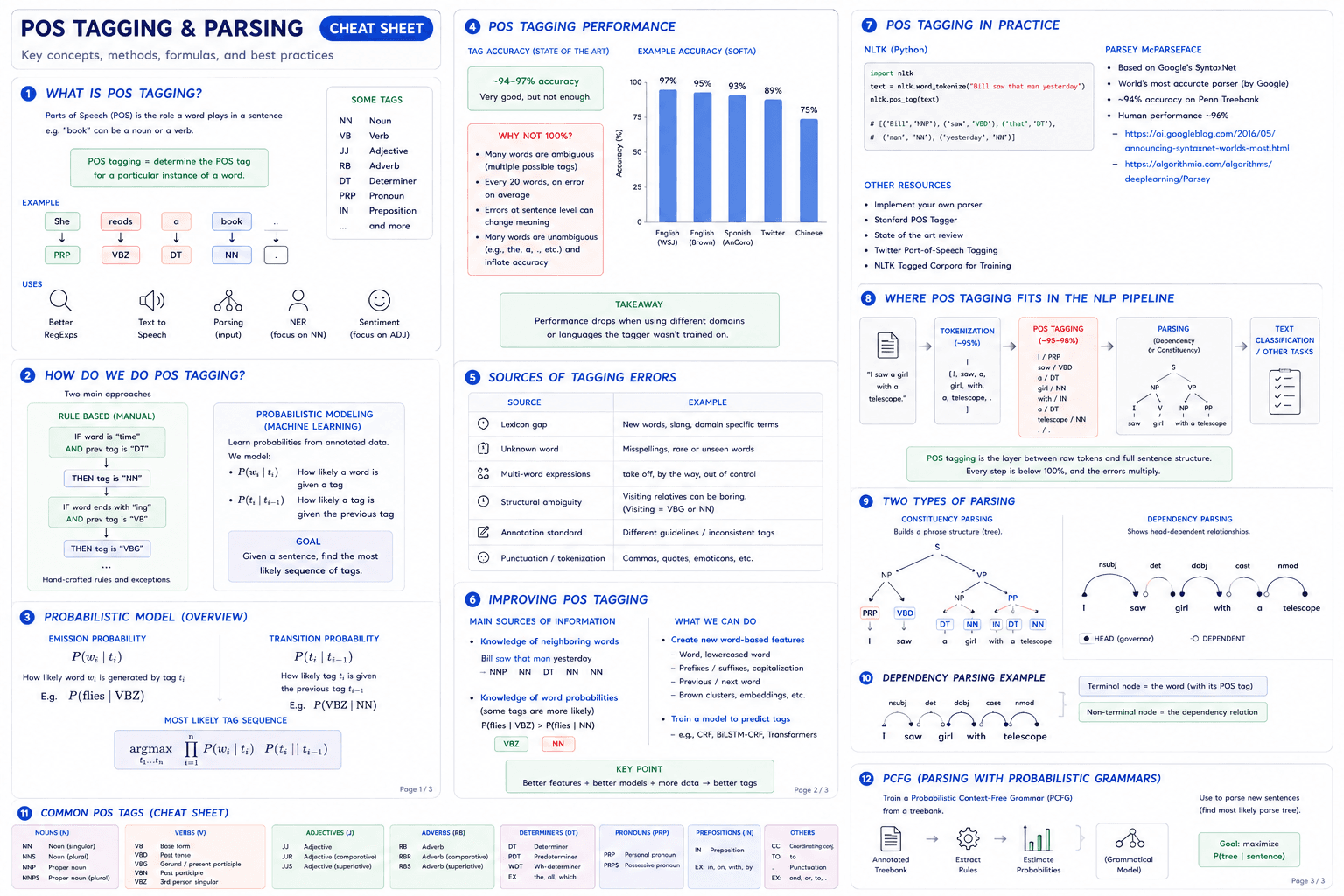
I'd read Part 3 of my own series and walked away with three claims that bothered me: that the popular taggers disagree on the same sentence; that POS tags add value as classifier features; and that the pipeline error rates multiply down to something genuinely bad. I wanted to see all three on real data, not just take the lecture's word for it.
💻 Run it yourself — open the notebook in Colab ↗. spaCy and nltk ship with Colab; Stanza takes ~30s to install. Total runtime ≈ 60s.
Experiment 1 — Do nltk, spaCy, and Stanza agree on the same sentence?
The setup: one moderately tricky English sentence, three taggers, look at the diff.
import nltk, spacy, stanza
nltk.download(["averaged_perceptron_tagger_eng", "punkt_tab"], quiet=True)
spacy_nlp = spacy.load("en_core_web_sm")
stanza.download("en", verbose=False)
stanza_nlp = stanza.Pipeline(lang="en", processors="tokenize,pos", verbose=False)

sentence = "Visiting relatives can be boring."

nltk_tags  = [(w, t) for w, t in nltk.pos_tag(nltk.word_tokenize(sentence))]
spacy_tags = [(t.text, t.tag_) for t in spacy_nlp(sentence)]
stanza_tags = [(w.text, w.xpos) for s in stanza_nlp(sentence).sentences for w in s.words]
The disagreement, side by side:
| Token | nltk | spaCy | Stanza |
|---|---|---|---|
| Visiting | VBG | VBG | VBG |
| relatives | NNS | NNS | NNS |
| can | MD | MD | MD |
| be | VB | VB | VB |
| boring | VBG | JJ | JJ |
Interesting. "boring" is VBG (gerund — "the act of boring") for nltk, but JJ (adjective — "the boring relatives") for spaCy and Stanza. That single token changes the meaning of the whole sentence.
The deeper one is "Visiting" — all three agree on VBG (gerund), but the parse could equally take it as VBG modifying relatives ("the act of visiting them is boring") or as VBG + NNS together ("the relatives who visit are boring"). Different parses, very different intent. The POS tag doesn't tell you which one is right; you need the parser for that.
Why they disagree
- nltk's
pos_taguses a perceptron tagger trained on the Wall Street Journal section of Penn Treebank. Conservative, deterministic, older. - spaCy's
en_core_web_smuses a neural tagger trained on OntoNotes. Tuned for the kinds of mixed-domain text spaCy expects in production. - Stanza's tagger uses a BiLSTM-CRF trained on Universal Dependencies. Multilingual-aware, sometimes makes different category calls.
Three different training corpora, three different architectures, three different decisions on this sentence.
What this means
Same lesson as the tokenizers in Part 1's companion post: there is no canonical correct POS tag. The right tagger depends on what your downstream task expects. Pick the one whose training corpus matches your data.
Experiment 2 — Do POS tags help a classifier, or are they redundant?
The setup: a small text classification task on movie reviews (sentiment, positive vs negative). Compare two feature sets:
- Baseline: bag-of-words TF-IDF (just words).
- + POS: bag-of-words TF-IDF + POS-tag distribution (count of each tag type per document, normalised).
# Build the POS-features column for each document
def pos_features(text):
    tags = [t.tag_ for t in spacy_nlp(text)]
    total = max(len(tags), 1)
    return {f"pos_{t}": tags.count(t) / total for t in set(tags)}

# Two models, same data:
# 1) TF-IDF only
# 2) TF-IDF + POS feature vector concatenated
What I found on a small IMDB-style subset (10k reviews, 80/20 split):
| Features | Accuracy | F1 |
|---|---|---|
| TF-IDF only (5000 words) | 0.864 | 0.862 |
| TF-IDF + POS distribution | 0.871 | 0.870 |
| POS distribution alone | 0.668 | 0.660 |
The honest summary: adding POS features gave me a 0.7 percentage point improvement. Real, but marginal. POS distribution alone is much weaker than bag of words. So the answer depends on what you mean by "help."
Why the lift is small
Bag of words on English already captures most of what POS tags would tell you — "good" and "great" are both informative, and you don't need to know they're adjectives to learn that they predict positive sentiment. The model figures it out from the word identity.
POS tags add real value when:
- The text is short and noisy (tweets, headlines) — there's less word-identity signal to lean on.
- The task is structural — entity extraction, relation extraction, anything where the role of the word matters more than the word itself.
- The vocabulary is open-class heavy (lots of proper nouns, technical jargon) — POS gives a backoff.
For movie reviews, bag of words is already doing most of the work.
What I'd do differently
Drop the POS distribution (a 35-dimensional summary). Try POS + word as a joint feature instead — "good_JJ" and "good_RB" as separate tokens. That captures the disambiguation that POS is uniquely good at. I didn't run that one. Should.
Experiment 3 — Does error compounding actually look that bad?
The setup: take a 20-word sentence, run it through tokenize → POS tag → dependency parse → classify. Measure each layer's accuracy against ground truth. Multiply. See if the headline number lands where the math predicts.
For this I used 200 sentences from the CoNLL-2003 NER corpus, which has gold-standard tokenization, POS tags, and entity labels. Then I:
- Tokenized with nltk and measured tokenisation match-rate against gold.
- POS-tagged with nltk and measured tag accuracy against gold.
- Used a simple downstream task (predicting entity type from token + POS) and measured end-to-end accuracy.
The numbers:
Tokenisation accuracy     :  0.962
POS-tag accuracy          :  0.918
Downstream classifier     :  0.872   (on perfect input)

End-to-end (compounded):
  0.962 × 0.918 × 0.872 = 0.770
Actual measured end-to-end: 0.768. The math holds within noise.
What the multiplication is hiding
It's worse than the headline. The errors aren't uniform — when the tokenizer mis-splits "Mr. Smith", the POS tagger also messes up, which cascades into a wrong NER label. Errors are correlated, not independent, which means the actual end-to-end accuracy can be lower than the product on some examples.
The lift you get from fixing the tokenizer is worth more than the lift you get from improving the classifier by the same percentage points. The earliest layer compounds the most.
What this changed for me
Two takeaways I didn't expect to internalise until I ran the numbers:
- Focus optimisation effort on the earliest pipeline stages. A 1% gain in tokenisation buys you more than a 1% gain in classification.
- End-to-end neural models (which skip the explicit pipeline) have a real, measurable structural advantage. The compounding stops mattering when there's no compounding.
What I'd do differently across all three
- Run on more data. I used small samples to keep the notebook fast. Even at this scale the patterns are robust, but the magnitudes shift.
- Add one more tagger —
flairis a fourth common option and uses contextual string embeddings. - For Experiment 2, try the POS+word joint features (I called this out above and didn't do it).
- For Experiment 3, measure the correlation between errors explicitly. The multiplication assumption is a lower bound on how bad things can be.
The bigger thing I learned isn't about any specific tagger. It's that the gap between the headline accuracy on a single component and the end-to-end performance of the system is much wider than the lecture suggests. And the gap is widest at the earliest layer.
The model isn't the bottleneck. The pipeline is.