
Table of Contents
- 1. The environment: LunarLander-v2 (optional partial observability)
- 2. PPO recap (short and practical)
- 3. Recurrent actor-critic architecture (LSTM)
- 4. Discounted returns and GAE advantages
- 5. Gathering trajectories (vector environments)
- 6. Splitting episodes and padding sequences
- 7. PPO update step
- 8. Hyperparameters and training setup
- 9. Training loop (full picture)
- 10. Evaluation and results
- 11. Practical takeaways
- 12. Common pitfalls and debugging checklist
- 13. Next improvements
- 14. End-to-end algorithm (expanded pseudocode)
- 15. Reproducibility checklist
- 16. FAQ (short answers)
- 17. Final thoughts
Last update: January 2026. All opinions are my own.
Reinforcement learning can feel like a black box until you build it yourself.
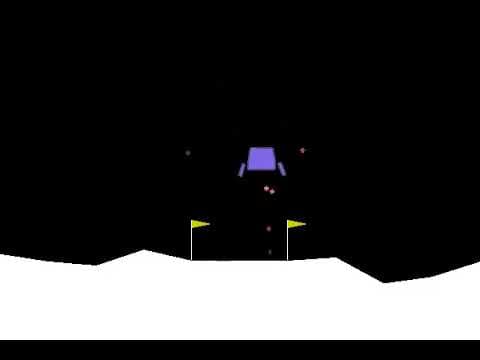
In this assignment, I train a PPO (Proximal Policy Optimization) agent in Gym's LunarLander-v2 to land precisely between two flags. The core setup uses standard PPO with reward shaping; I also include an optional recurrent (LSTM) extension for partial observability.
We will cover:
- Why PPO works well in practice (and when it fails)
- Optional: recurrence (LSTM) for partial observability
- How to gather trajectories efficiently (vector environments)
- How to compute discounted returns and GAE advantages
- How to implement the PPO clipped objective
- Optional: how to batch sequences for recurrent training
- A realistic hyperparameter starting point
- Evaluation strategy and common failure modes
- Pseudocode for the full algorithm (end-to-end)
- A reproducibility checklist (seeds, metrics, checkpoints)
- A complete training loop with logging and checkpoints
1) The environment: LunarLander-v2 (optional partial observability)
LunarLander-v2 provides an 8D observation vector and expects a discrete action:
0: do nothing1: fire left engine2: fire main engine3: fire right engine
The observation vector is 8-dimensional and (roughly) contains:
- x position
- y position
- x velocity
- y velocity
- angle
- angular velocity
- left leg contact
- right leg contact
To make the problem more interesting, I intentionally remove velocity information. This turns the task into a partially observable MDP, where memory becomes useful.
class MaskVelocityWrapper(gym.ObservationWrapper):
    # Mask velocity terms to make the environment partially observable.
    def __init__(self, env):
        super().__init__(env)
        if ENV == "LunarLander-v2":
            self.mask = np.array([1., 1., 0., 0., 1., 0., 1., 1.])
    def observation(self, observation):
        return observation * self.mask
With this wrapper enabled, the agent cannot observe velocity directly and must infer motion over time. That is exactly what LSTMs are good at.
In this specific mask, I remove both linear velocities and angular velocity. If you want an easier partial observability setting, mask only x_dot and y_dot and keep angular velocity.
Reward signal (default + shaping ideas)
LunarLander's built-in reward already encourages landing between the flags, staying upright, and touching down gently. In this project I keep the default reward, but there are a few simple shaping terms you can experiment with:
- Add a penalty for horizontal distance to the landing zone center.
- Add a penalty for high vertical speed right before touchdown.
- Add a small bonus for keeping both legs in contact after landing (stability).
Shaping is optional; PPO can learn with the stock reward, but careful shaping can make learning faster and more consistent.
Be conservative with shaping. If a shaping term dominates the reward, the agent can learn to “game” that term while ignoring the true objective (e.g., hovering near the pad but never landing).
2) PPO recap (short and practical)
PPO is a policy-gradient method that keeps updates stable by limiting how much the policy can change at each step.
The key quantity is the probability ratio:
PPO maximizes a clipped objective:
The full loss usually adds value loss and an entropy bonus:
Two small but important implementation details:
- Normalize advantages within each batch to stabilize gradients.
- Clip value loss if the critic becomes unstable (optional but helpful).
advantages = (advantages - advantages.mean()) / (advantages.std() + 1e-8)PPO health metrics (track these)
When PPO diverges, it usually shows up in a few metrics first:
- Approximate KL between old and new policy (too high = updates too large).
- Clip fraction (fraction of samples that were clipped; too high = overly aggressive updates).
- Entropy (drops too fast = premature convergence).
with torch.no_grad():
    approx_kl = (old_log_probs - new_log_probs).mean()
    clip_frac = (torch.abs(ratio - 1.0) > hp.ppo_clip).float().mean()
3) Recurrent actor-critic architecture (LSTM)
I use an actor-critic setup:
- Actor outputs a policy distribution
- Critic estimates the value
Both are LSTMs, so they can accumulate memory across timesteps.
Actor (policy network)
class Actor(nn.Module):
    def __init__(self, state_dim, action_dim, continuous_action_space, trainable_std_dev, init_log_std_dev=None):
        super().__init__()
        self.lstm = nn.LSTM(state_dim, hp.hidden_size, num_layers=hp.recurrent_layers)
        self.layer_hidden = nn.Linear(hp.hidden_size, hp.hidden_size)
        self.layer_policy_logits = nn.Linear(hp.hidden_size, action_dim)
        self.hidden_cell = None
    def get_init_state(self, batch_size, device):
        self.hidden_cell = (
            torch.zeros(hp.recurrent_layers, batch_size, hp.hidden_size).to(device),
            torch.zeros(hp.recurrent_layers, batch_size, hp.hidden_size).to(device),
        )
    def forward(self, state, terminal=None):
        batch_size = state.shape[1]
        device = state.device
        if self.hidden_cell is None or batch_size != self.hidden_cell[0].shape[1]:
            self.get_init_state(batch_size, device)
        # Reset memory when episodes end
        if terminal is not None:
            self.hidden_cell = [
                value * (1. - terminal).reshape(1, batch_size, 1)
                for value in self.hidden_cell
            ]
        _, self.hidden_cell = self.lstm(state, self.hidden_cell)
        hidden_out = F.elu(self.layer_hidden(self.hidden_cell[0][-1]))
        logits = self.layer_policy_logits(hidden_out)
        # Discrete action space -> categorical distribution
        policy_dist = distributions.Categorical(F.softmax(logits, dim=1).to("cpu"))
        return policy_dist
Two details matter here:
- Reset LSTM state on episode boundaries to avoid leaking memory across episodes.
- Build the Categorical distribution on CPU to avoid CUDA memory issues.
Critic (value network)
class Critic(nn.Module):
    def __init__(self, state_dim):
        super().__init__()
        self.layer_lstm = nn.LSTM(state_dim, hp.hidden_size, num_layers=hp.recurrent_layers)
        self.layer_hidden = nn.Linear(hp.hidden_size, hp.hidden_size)
        self.layer_value = nn.Linear(hp.hidden_size, 1)
        self.hidden_cell = None
    def get_init_state(self, batch_size, device):
        self.hidden_cell = (
            torch.zeros(hp.recurrent_layers, batch_size, hp.hidden_size).to(device),
            torch.zeros(hp.recurrent_layers, batch_size, hp.hidden_size).to(device),
        )
    def forward(self, state, terminal=None):
        batch_size = state.shape[1]
        device = state.device
        if self.hidden_cell is None or batch_size != self.hidden_cell[0].shape[1]:
            self.get_init_state(batch_size, device)
        if terminal is not None:
            self.hidden_cell = [
                value * (1. - terminal).reshape(1, batch_size, 1)
                for value in self.hidden_cell
            ]
        _, self.hidden_cell = self.layer_lstm(state, self.hidden_cell)
        hidden_out = F.elu(self.layer_hidden(self.hidden_cell[0][-1]))
        value_out = self.layer_value(hidden_out)
        return value_out
Batch and time dimensions
PyTorch LSTMs expect input with shape (seq_len, batch, features) by default. That means you should stack timesteps along the first dimension and keep parallel environments along batch.
For example:
states:(T, N, obs_dim)actions:(T, N)hidden_state:(num_layers, N, hidden_size)
Keeping this consistent avoids subtle bugs when you later split episodes and pad sequences.
Sequence handling (why this is tricky)
Recurrent PPO is not just "PPO with an LSTM". You need to make sure:
- Each environment keeps its own hidden state.
- You reset hidden states on terminal steps only.
- You keep sequence order when building minibatches.
- You pad sequences and apply masks so loss ignores padded timesteps.
If any of those are wrong, the agent will still run, but performance will be erratic.
4) Discounted returns and GAE advantages
PPO needs two signals:
- Discounted returns (targets for the critic)
- Advantages (signals for the actor)
Discounted return
def calc_discounted_return(rewards, discount, final_value):
    seq_len = len(rewards)
    discounted_returns = torch.zeros(seq_len)
    discounted_returns[-1] = rewards[-1] + discount * final_value
    for i in range(seq_len - 2, -1, -1):
        discounted_returns[i] = rewards[i] + discount * discounted_returns[i + 1]
    return discounted_returns
Generalized Advantage Estimation (GAE)
def compute_advantages(rewards, values, discount, gae_lambda):
    deltas = rewards + discount * values[1:] - values[:-1]
    seq_len = len(rewards)
    advs = torch.zeros(seq_len + 1)
    multiplier = discount * gae_lambda
    for i in range(seq_len - 1, -1, -1):
        advs[i] = advs[i + 1] * multiplier + deltas[i]
    return advs[:-1]
A few details that matter in practice:
- Bootstrapping: the final value estimate should be zero if the episode ended, otherwise use the critic value.
- Masking terminals: make sure you do not leak value estimates across episode boundaries.
- Lambda: lower values reduce variance but increase bias. 0.95 is a good starting point.
5) Gathering trajectories (vector environments)
PPO is on-policy, so every iteration starts with fresh rollouts. I use a vectorized environment to gather experience from multiple environments in parallel:
env = gym.vector.make(ENV, hp.parallel_rollouts, asynchronous=ASYNCHRONOUS_ENVIRONMENT)This speeds up data collection and reduces gradient noise.
The rollout buffer stores:
- states
- actions
- log probabilities
- rewards
- values
- terminal flags
- actor and critic LSTM states
def gather_trajectories(input_data):
    env = input_data["env"]
    actor = input_data["actor"]
    critic = input_data["critic"]
    obsv = env.reset()
    terminal = torch.ones(hp.parallel_rollouts)
    trajectory_data = {
        "states": [],
        "actions": [],
        "action_probabilities": [],
        "rewards": [],
        "true_rewards": [],
        "values": [],
        "terminals": [],
        "actor_hidden_states": [],
        "actor_cell_states": [],
        "critic_hidden_states": [],
        "critic_cell_states": [],
    }
    with torch.no_grad():
        actor.get_init_state(hp.parallel_rollouts, GATHER_DEVICE)
        critic.get_init_state(hp.parallel_rollouts, GATHER_DEVICE)
        for _ in range(hp.rollout_steps):
            trajectory_data["actor_hidden_states"].append(actor.hidden_cell[0].squeeze(0).cpu())
            trajectory_data["actor_cell_states"].append(actor.hidden_cell[1].squeeze(0).cpu())
            trajectory_data["critic_hidden_states"].append(critic.hidden_cell[0].squeeze(0).cpu())
            trajectory_data["critic_cell_states"].append(critic.hidden_cell[1].squeeze(0).cpu())
            state = torch.tensor(obsv, dtype=torch.float32)
            trajectory_data["states"].append(state)
            value = critic(state.unsqueeze(0).to(GATHER_DEVICE), terminal.to(GATHER_DEVICE))
            trajectory_data["values"].append(value.squeeze(1).cpu())
            action_dist = actor(state.unsqueeze(0).to(GATHER_DEVICE), terminal.to(GATHER_DEVICE))
            action = action_dist.sample().squeeze(1)
            trajectory_data["actions"].append(action.cpu())
            trajectory_data["action_probabilities"].append(action_dist.log_prob(action).cpu())
            obsv, reward, done, _ = env.step(action.cpu().numpy())
            terminal = torch.tensor(done).float()
            trajectory_data["rewards"].append(torch.tensor(reward).float())
            trajectory_data["terminals"].append(terminal)
        state = torch.tensor(obsv, dtype=torch.float32)
        value = critic(state.unsqueeze(0).to(GATHER_DEVICE), terminal.to(GATHER_DEVICE))
        trajectory_data["values"].append(value.squeeze(1).cpu() * (1 - terminal))
    return {k: torch.stack(v) for k, v in trajectory_data.items()}
Two extra tips:
- Track time limits. If an episode ends due to a time limit, treat it as a truncated episode and bootstrap value instead of zeroing it.
- Keep rollouts small enough to avoid GPU memory spikes when stacking sequences.
6) Splitting episodes and padding sequences
Vector environments reset automatically, which means a single rollout buffer contains many episodes. I split trajectories on done=True, pad them to a fixed length, and then compute returns and advantages per episode.
This is critical for recurrent training because you want clean, consistent sequences.
A minimal outline looks like this:
def split_and_pad(buffer, max_len):
    episodes = []
    current = []
    for t in range(buffer_len):
        current.append(step_t)
        if done_t:
            episodes.append(current)
            current = []
    padded = [pad(ep, max_len) for ep in episodes]
    masks = [make_mask(ep, max_len) for ep in episodes]
    return padded, masks
The mask is essential. It tells the loss which timesteps are real and which are padding.
Here is a simple masked loss pattern:
masked_adv = advantages * mask
masked_logp = logp * mask
actor_loss = -(masked_logp * masked_adv).sum() / mask.sum()
If you prefer not to pad, you can use pack_padded_sequence to let the LSTM skip padded timesteps entirely. Padding + masking is simpler and works well, but packing is often more memory efficient.
7) PPO update step
Once we have batches, PPO updates both networks.
Actor loss (clipped objective)
action_dist = actor(batch.states)
action_probabilities = action_dist.log_prob(batch.actions[-1, :].to("cpu")).to(TRAIN_DEVICE)
ratio = torch.exp(action_probabilities - batch.action_probabilities[-1, :])
surrogate_0 = ratio * batch.advantages[-1, :]
surrogate_1 = torch.clamp(ratio, 1. - hp.ppo_clip, 1. + hp.ppo_clip) * batch.advantages[-1, :]
entropy = action_dist.entropy().to(TRAIN_DEVICE)
actor_loss = -torch.mean(torch.min(surrogate_0, surrogate_1)) - torch.mean(hp.entropy_factor * entropy)
Critic loss (value regression)
values = critic(batch.states)
critic_loss = F.mse_loss(batch.discounted_returns[-1, :], values.squeeze(1))
Stability helpers
I also recommend:
- Gradient clipping (e.g.
max_grad_norm = 0.5) - Mini-batch updates over sequences instead of full batch
- Early stopping when KL divergence explodes
Example KL early-stop check:
if approx_kl > 0.02:
    break
8) Hyperparameters and training setup
Here is a reasonable starting point for LunarLander with recurrence. Use this as a baseline and tune from there:
parallel_rollouts: 8
rollout_steps: 256
ppo_epochs: 4
minibatch_size: 64
learning_rate: 3e-4
hidden_size: 128
recurrent_layers: 1
ppo_clip: 0.2
gamma: 0.99
gae_lambda: 0.95
entropy_factor: 0.01
value_coef: 0.5
max_grad_norm: 0.5
If training is unstable, the first two knobs to try are learning rate and clip range.
Other common tuning levers:
- Rollout length: longer rollouts reduce bias but increase variance and memory.
- Entropy factor: higher keeps exploration longer; too high prevents convergence.
- Hidden size: larger LSTM can help partial observability, but increases compute.
Three tuned options (for LunarLander-v2)
Below are three configurations adapted to LunarLander-v2. Start with Option A to validate end-to-end training, then try B or C only after the loop is stable.
Option A (recommended): Stable baseline for LunarLander-v2 ✅
Why this one: closest to safe defaults (reasonable LR, not too many PPO epochs, moderate batch), so it is least likely to explode while you are validating the pipeline.
# Environment parameters
ENV: "LunarLander-v2"
EXPERIMENT_NAME: "ll-v2-baseline"
ENV_MASK_VELOCITY: true
# Default Hyperparameters
SCALE_REWARD: 0.01
MIN_REWARD: -1000.0
HIDDEN_SIZE: 128
BATCH_SIZE: 64
DISCOUNT: 0.999
GAE_LAMBDA: 0.98
PPO_CLIP: 0.2
PPO_EPOCHS: 8
MAX_GRAD_NORM: 1.0
ENTROPY_FACTOR: 0.01
ACTOR_LEARNING_RATE: 0.0003
CRITIC_LEARNING_RATE: 0.0003
RECURRENT_SEQ_LEN: 8
RECURRENT_LAYERS: 1
ROLLOUT_STEPS: 1024
PARALLEL_ROLLOUTS: 8
PATIENCE: 200
TRAINABLE_STD_DEV: false
INIT_LOG_STD_DEV: 0.0
Option B: Faster learning (a bit more “pushy”) ⚡️
Why this one: can learn faster once everything runs, but it is more sensitive (more PPO updates, larger critic LR).
ENV: "LunarLander-v2"
EXPERIMENT_NAME: "ll-v2-faster"
ENV_MASK_VELOCITY: true
SCALE_REWARD: 0.01
MIN_REWARD: -1000.0
HIDDEN_SIZE: 128
BATCH_SIZE: 64
DISCOUNT: 0.999
GAE_LAMBDA: 0.98
PPO_CLIP: 0.2
PPO_EPOCHS: 16
MAX_GRAD_NORM: 1.0
ENTROPY_FACTOR: 0.01
ACTOR_LEARNING_RATE: 0.0003
CRITIC_LEARNING_RATE: 0.001
RECURRENT_SEQ_LEN: 8
RECURRENT_LAYERS: 1
ROLLOUT_STEPS: 1024
PARALLEL_ROLLOUTS: 8
PATIENCE: 200
TRAINABLE_STD_DEV: false
INIT_LOG_STD_DEV: 0.0
Option C: Throughput / efficiency (bigger batches) 🧱
Why this one: more stable gradients and fewer noisy updates, but heavier on memory/compute.
ENV: "LunarLander-v2"
EXPERIMENT_NAME: "ll-v2-bigbatch"
ENV_MASK_VELOCITY: true
SCALE_REWARD: 0.01
MIN_REWARD: -1000.0
HIDDEN_SIZE: 128
BATCH_SIZE: 512
DISCOUNT: 0.999
GAE_LAMBDA: 0.98
PPO_CLIP: 0.2
PPO_EPOCHS: 10
MAX_GRAD_NORM: 0.5
ENTROPY_FACTOR: 0.01
ACTOR_LEARNING_RATE: 0.0015
CRITIC_LEARNING_RATE: 0.0015
RECURRENT_SEQ_LEN: 8
RECURRENT_LAYERS: 1
ROLLOUT_STEPS: 512
PARALLEL_ROLLOUTS: 8
PATIENCE: 200
TRAINABLE_STD_DEV: false
INIT_LOG_STD_DEV: 0.0
What I would do: start with Option A until env creation works, the loop runs end-to-end, and logs/checkpoints look sane. Then try Option B if learning is too slow, or Option C if you want smoother updates.
9) Training loop (full picture)
Each PPO iteration looks like this:
- Gather trajectories
- Split episodes
- Compute returns and advantages
- Train for several PPO epochs
- Log metrics and save checkpoints
Minimal pseudocode:
for iteration in range(num_iters):
    buffer = gather_trajectories(env, actor, critic)
    episodes, masks = split_and_pad(buffer, max_len)
    returns, advs = compute_returns_and_advs(episodes, masks)
    for epoch in range(ppo_epochs):
        for batch in make_sequence_batches(episodes, masks, returns, advs):
            update_actor_critic(batch)
During training, I print progress like:
Iteration: 9, Mean reward: -79.63, Mean Entropy: 1.21, complete_episode_count: 194.0Reward improved quickly early on, while entropy slowly decreased as the policy became more confident.
10) Evaluation and results
For evaluation, I run the policy deterministically (take argmax action) and average reward over 10 to 20 episodes. This removes stochasticity from the metric and makes progress easier to see.
Common success signals:
- Average reward consistently above 200
- Stable landings with low vertical speed
- Few crashes after training stabilizes
If results stall, try training longer (more total environment steps) or widening the LSTM hidden size.
I also recommend:
- Keep evaluation and training wrappers consistent (same observation masking).
- Log both train reward and eval reward to detect overfitting.
- Fix a small set of evaluation seeds for smoother curves.
11) Practical takeaways
- Recurrent PPO is mostly about correct bookkeeping (hidden states, episode boundaries, sequence batching).
- Vector environments make training much faster and smoother.
- PPO is stable, but hyperparameters still matter: learning rate, clip range, entropy coefficient, batch size, rollout length.
- Advantage normalization can make the difference between learning and divergence.
12) Common pitfalls and debugging checklist
- Hidden state not reset on done: the agent leaks memory between episodes.
- Masking bugs: padding timesteps are accidentally included in the loss.
- Action log-prob mismatch: storing log-probs from CPU but recomputing on GPU without care.
- Time-limit truncation: treating truncations as terminal states hurts value estimates.
- Batch order: shuffling sequences without keeping time order can break recurrence.
- Seed drift: evaluation and training use different seeds and you misread progress.
- Exploding gradients: forget to clip and training silently destabilizes.
- Wrong tensor shapes: feeding
(batch, time, feat)into an LSTM expecting(time, batch, feat).
A quick sanity test is to disable the LSTM and verify that your PPO baseline still learns. If it does, the recurrence logic is likely the issue.
13) Next improvements
If I extend this project, I want to:
- Normalize advantages per batch
- Add value function clipping
- Train longer (1M+ steps)
- Compare with Stable-Baselines3 RecurrentPPO
- Try a GRU-based actor-critic as a lighter baseline
14) End-to-end algorithm (expanded pseudocode)
This is the full logic in one place, with the recurrent pieces highlighted:
for iteration in range(num_iters):
    # 1) Rollout
    actor.get_init_state(N, device)
    critic.get_init_state(N, device)
    buffer = []
    obs = env.reset()
    done = torch.ones(N)
    for t in range(rollout_steps):
        # Save hidden states BEFORE stepping
        buffer.append({
            "obs": obs,
            "done": done,
            "actor_h": actor.hidden_cell,
            "critic_h": critic.hidden_cell,
        })
        dist = actor(obs, done)
        action = dist.sample()
        value = critic(obs, done)
        next_obs, reward, done, info = env.step(action)
        buffer[-1].update({"action": action, "reward": reward, "value": value})
        obs = next_obs
    # 2) Split into episodes, pad, and mask
    episodes, masks = split_and_pad(buffer, max_len)
    # 3) Compute returns and advantages per episode
    returns, advs = compute_returns_and_advs(episodes, masks)
    # 4) PPO updates (sequence minibatches)
    for epoch in range(ppo_epochs):
        for batch in make_sequence_batches(episodes, masks, returns, advs):
            update_actor_critic(batch)
15) Reproducibility checklist
If you want learning curves you can trust:
- Fix random seeds for Python, NumPy, PyTorch, and the environment.
- Log train reward, eval reward, KL, clip fraction, and entropy.
- Save checkpoints regularly and keep a “best so far” snapshot.
- Track the exact hyperparameters used for each run.
- Record environment versions (Gym/Gymnasium) and hardware info.
16) FAQ (short answers)
Do I really need an LSTM?
Not always. If you remove the velocity mask, a feed-forward PPO should solve LunarLander. The LSTM is mainly to handle partial observability.
Why does the agent learn but then collapse?
Usually the learning rate is too high, the clip range is too wide, or the value loss is overpowering the policy loss.
How many steps does it take to learn?
It depends on hyperparameters and reward shaping. Recurrent setups typically need more steps than feed-forward PPO.
Final thoughts
Implementing PPO from scratch is one of the best ways to build intuition for reinforcement learning. Adding recurrence makes it harder, but also much more realistic for partially observable environments.
If you are learning RL, I strongly recommend implementing PPO at least once. Even if you later switch to libraries, you will understand exactly what they are doing.